Can you teach? Can anybody?

Standard

improvised-shakespeare-company
I used to teach, and for a long time, I tried to do it “their” way–the ones who taught us: construct your lectures from primary sources and the most current research, insert them into the teaching space/arena, repeat. It’s okay not to allow questions.
Look what happens if you allow questions–things can go anywhere. Can you bring them back? Can anybody? What about that point to be made? So why would you ever allow questions?
But there were a few insurrectionists, like the film teacher, and you could find out that some people allowed that kind of pandemonium in their classrooms. Of course, they were labelled kooks or unprepared or just not very smart. And you told yourself only some subjects permitted it.
But my own teaching began to bore me and I felt more and more like a fraud, standing up there delivering “the word.”
So, gradually I couldn’t help myself, and I began to allow questions. Well, all hell broke lose. They had opinions that challenged my “established knowledge,” many of them said the first un-thought thing that popped into their heads, some felt they had “the word” because they were in touch with the media–social and otherwise, some were just full of themselves. But more than a few were about more than themselves and made me think, and for a while I flew by the seat of my pants with them.
That became my definition of teaching–teacher and student flying by the seat of their pants. They begin in the realm of the subject matter at hand and see where it takes them. Both can end up going somewhere neither have been. And it’s fun.
I think it’s how the best writing happens–a conversation with you and your muse/source/etc.
I liken the process to improv, a practice that hands us back ourselves, often through a process of standing up to our own immense fear of exactly that.
The only thing to be nervous about, as one long form improviser said, “is the potential for large-scale humiliation.”

See Patrick Stewart talk about improvising Shakespeare: http://americantheatre.org/2014/11/how-patrick-stewart-learned-to-die-onstage/
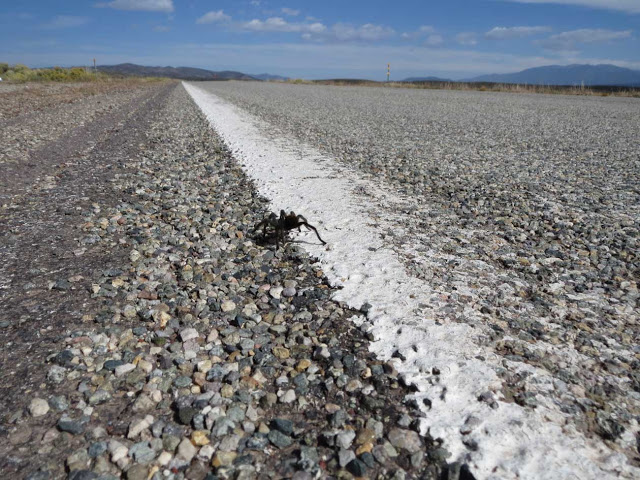

Tarantula Migration–Can they get in the car?

Standard

tarantula2

I lived in Roswell, NM, for about five years. I managed an HIV agency that served the southeastern quadrant of the state, 33,000 square miles, which was pretty impossible, with about 126 clients, so I did a lot of driving on little-traveled roads.
One night, driving home late, I was brought out of my usual driving stupor by catching sight of lots of small crawling things on the road. Tarantulas! I slowed but couldn’t help running over some of them and began to wonder if they could get into the car. What are they running from? Was it the end of the world? Would I be swarmed by them?
I didn’t know it at the time, but it was the annual tarantula migration. The males go in search, in mass, for female companionship. I couldn’t have imagined such a thing–except in a nightmare. I was horrified.
I later learned that a tarantula bite probably won’t kill you. I learned, too, that they’re gentle arachnids, nocturnal and shy, despite how scary they look.
I saw lots of other living things on the back roads I traveled–ring-tailed cats (just like out of Dr. Seuss), badger families, crowds of migrating jack rabbits lining the road, petite silver wolves, hawks, eagles–but I always remembered the tarantulas. Alone as I was, in the dark, being surrounded by lots of spiders (one of my worst fears), knowing I just had to get through it, wondering if it was a dream.
Lots of people think that part of NM is a wasteland, devoid of life, a desert. But it’s full of life, going about its business, searching for other like-minded partners, like we do.
What else don’t we know?

Photo from: rebeccamezoff.blogspot.com

Tasmania–running into the other you

Standard

launceston
Excerpt from Jumping: a Novel.
Babe has jumped into the Void and is meeting an aspect of herself whom she almost met in life:

One of them is a woman I saw once, in Tasmania. I’m surprised to see a woman with whom I have had only one encounter, and we never even spoke. . . .

I take in the woman, who looks strikingly like me, and remember seeing her in the crowd of evening strollers along the pier one night, on the Tamar River. . . I felt so strangely drawn to follow this woman, knowing there was some sort of connection, and hoping she knew it, too.

I think she was afraid of me—she noticed me, but only peripherally, and wouldn’t look at me head-on. I was a little freaked out—knowing she was me somehow, some other version of me. I wanted to see her and have her see me, as validation of something, but at the same time I felt as if something irrevocable would change, and I didn’t know if I was ready for that. I think she felt the same way.

The woman approaches. The silence lingers.

“Babe, this is Hardin,” Philip says, just as I’m thinking the name in my head.

“I know.”

Hardin and I hug. And Hardin, laughing, says, with a distinct Australian accent, “Of course, I did see you. I’m an aspect of you and you of me. It was my first time to ever see such a thing. I wasn’t well at the time, and I thought seeing you meant immanent death!” She laughs again, “I know now that’s not the case. And I’m sorry to have missed the opportunity, but I was a frightful little thing in that life. Not like you!”

“Oh, I was scared, too!” I reassure her.

The Snake

Standard

Water drops on blue background

From Jumping: a Novel.
Babe, on the arrival of her sisters. [I have three sisters.]

“I remember seeing a snake come down from the porch roof of a cabin I was staying in with friends. As we watched, it extended half of its length down through space as if the space had substance to support it, leaving its other half anchored on the porch roof. It lowered that front half right into a fir tree leaning against the porch, into the nest of a small mourning dove, a nest clearly visible to our group on the porch, a nest with two small eggs in it.
The dove had left the nest, probably because we had scared her off by coming out on the porch, and the snake had seen its chance. It moved into the nest with half of its body still on the porch roof, and swallowed both eggs, so quickly, so effortlessly, I could almost believe it hadn’t happened. I didn’t want to believe it had. Then it withdrew itself back up onto the roof, again as if suspended by invisible wires, and disappeared from sight. We stood there, silenced by the finality of its act. . . .
“Later I found a snakeskin tucked in the fold of the bottom step of the back porch. It was beautiful, elegant, like a woman’s elbow-length opera glove, dropped unheedingly, while she was on her way to somewhere else. . . .”

Keep the Channel Open

Standard

DR jumping
“It is not your business to determine how good it is nor how valuable nor how it compares with other expressions. It is your business to keep it yours clearly and directly, to keep the channel open. You do not even have to believe in yourself or your work. You have to keep yourself open and aware to the urges that motivate you. Keep the channel open.”
“There is no satisfaction whatever at any time. There is only a queer divine dissatisfaction, a blessed unrest that keeps us marching and makes us more alive than the other.”

The best thing I’ve read in a long time on why we do what we do:

http://99u.com/articles/34649/7-pieces-of-wisdom-that-will-change-the-way-you-work

Why I jumped.

Standard

jumping rope

From Jumping: a Novel.
Babe, the narrator is speaking.
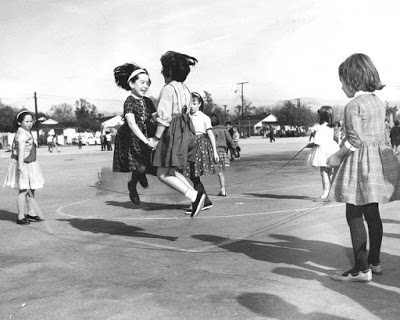
“I can remember the first time I jumped rope,” I remember out loud to Miles, “with my sisters holding the ends of the rope, not sure I could navigate the timing and the sweep of the rope, not believing I was as smart and as quick as they were. I have to admit that I was pretty impressed with myself when I knew the rope had cleared the ground under my feet. Then I got my rhythm, and it felt easier. I forgot the sense of accomplishment I got from that. What a rite of passage that was. I had forgotten.”
He laughed and gave a little two-footed jump, shouting back, “That’s what I’m talking about! You made your own jump! And we don’t really forget our jumps. They leave their mark. What would it feel like to you if you jumped right now, Babe–right where you are, not into the Void or even out of a swing? You just jumped. Why can’t we still do it?”

Jumping: a Novel is available at Amazon: http://www.amazon.com/s/ref=nb_sb_ss_i_0_14?url=search-alias%3Dstripbooks&field-keywords=jane+peranteau&sprefix=jane+peranteau%2Cstripbooks%2C327

Photo: Herald Examiner Collection, 1976. LA Public Library Photo Archives. Girls jumping rope at elementary school in Riverside, CA, cheering for summer vacation.

Life is to short to play it safe.

Standard

I discovered if you don’t regularly jump–off a porch, from a plane, into a new life–you’re not living. Life loses its juice and so do you. For every time I left town with a suitcase and never went back, I grew leaps as a human being–I think jumping is a shortcut to living. When do you feel more alive than when you take a risk, a life leap, a free fall?

Liking our Female Characters II

Standard

Carrie Jean in Jumping:

“We were both tall, like our mother. Made for horses, Granny said. She kept our hair like she had our mother’s, according to tradition, long and never cut.”

“I don’t know our heritage for sure. I think we’re Algonquin and Sioux and Navajo, but I think there’s some African slave and French Canadian in there, too, and maybe even some Irish. You tell me what to make of it. Maybe it’s no different for you.”

“I have lots of Void stories. The Tribe watches over the Void. At night, I stand in the dark, watching the Void breathe. The ground swells as it draws breath and sinks when that breath is expelled in a shower of colorful living sparks that shoot far up into the night sky.  The Ancestors, our larger Tribe, come from the Void to watch, colorful and glowing in the dark themselves. ‘Those are messages for those searching,’ they tell me, pointing at the disappearing sparks, ‘so their hearts don’t become empty shelters for anyone’s messages.'”

I think good female characters are messengers themselves, telling us what we need to know so that we don’t go too badly astray. We get the message not just from who they are when they step into our story, but as we learn who they are in their entirety–past and present, and who they might become as this story unfolds.

Carrie Jean is a main character in Jumping. She calls herself a part-time Indian (a term from Sherman Alexie) because she’s still working out the tribal intermarriages, displacements, abandonments, and the conflicting stories that give them context.  She’s lost more family than she’s kept, and she’s a recovering griever, recovering the wisdom bound up in the experiencing of all those losses. We witness who she is becoming as she spends time in the company of the Void, wondering if she will find her family there. She knows the Void is a keeper of all that we lose–either because we tossed it away or because it left before we knew to stop it.

I’m caught up in who she is becoming. I like her.


Liking our female characters

Standard

ScottandBaileycast

I’m writing about a lead character who is going to jump into the Void, and I want to like her more.  Isn’t it enough that she has the courage to jump? What’s missing?  I think about the female characters I like–most recently, Scott & Bailey, the detectives on a PBS series (that’s them above, with their boss on the left).  Why do I like them?  I have to admit the truth–it’s because they smoke, drink, and make bad relationship decisions.  And they might have tattoos.  They’re a mixture of girly-girls (make-up, skirts, heels), bad girls (smoking, drinking, etc.), and smart girls (we have evidence of this, usually in their work).

But I discover there’s something else that’s part of the hook–they have some kind of inner courage, every-day courage, the kind no one else usually knows about but that is a defining pattern for them. They hold steady on this. That’s what I want to see in my lead character–something that isn’t publicly seen but that is regularly practiced, that helps us understand her jump.  Other women might have a pattern of drama, a pattern of manipulation, a pattern of hiding, even a pay-it-forward pattern of kindness.  But these women have a consistent pattern of courage born from living against the grain.

If they come up against rejection, abandonment, violence, they don’t stick at that spot, memorializing it so that they can borrow from it later.  They’ll either take it aboard or they’ll discard it, but–either way–they move on.  They aren’t held back a grade because they haven’t gotten what came before.  They decide and move on.

I think it’s a hard thing to have.  Life pounds and pulls, telling them they’re weak or stupid or crazy, but bent and weather beaten, they stand, deciding against the grain.

For me, that makes these characters jumpers–women who would. Without making a fuss about it.  It’s what will make my lead character a jumper.

And I don’t think they’re alone out there.

I think that’s what you might be, if you’re reading this. A jumper. That’s what keeps me writing to you. I’m looking for the jumpers.


Are you selling out when you sell yourself? Sure!

Standard

You can’t let it change you.  Then it’s not selling out.  But is that even possible?  Nowadays, if you’re a writer, you’re in sales.  We just used to think someone else would be doing it for us.

The other day, the 21 year old technical whiz who works with me and I produced the first draft of a video for youtube.  The publisher will either edit it and put it up or send us back to the drawing board.  Their marketing person said two minutes, don’t read, talk about the book, but don’t give it away.  Right now, we’re at five minutes and six seconds.  And we’ve got lots of out-takes.  A couple of times we got to laughing and almost couldn’t stop. The techie/director took care of lighting, sound, time, setting, wardrobe, hair frizzies, script management, feedback, production design, and more.  I supplied the script and showed up.  That was a lot!

I think the truth is my apprehension, at core, comes from the fact that I’m still getting to know the book.  I wrote it and moved on to the next one.  Now I look at it and try to remember.  I’m surprised and unsettled by the comments of others who’ve recently read it.  They’ve seen something I didn’t know was there and been moved by it.  The book is clearly a thing unto itself.

I will say, as I go back into Jumping, looking for things to quote or things for readings, I find a lot I remember and still like.  Maybe that’s because I know the book wasn’t written just by me.  Go, little book!