2015 in review

Standard

The WordPress.com stats helper monkeys prepared a 2015 annual report for this blog.

Here’s an excerpt:

A San Francisco cable car holds 60 people. This blog was viewed about 400 times in 2015. If it were a cable car, it would take about 7 trips to carry that many people.

Click here to see the complete report.

“…if I had my goddam choice…”

Standard

?????????????????????????????????????????????????????????????????????????????????
“You know what I’d like to be?” I said. “I mean if I had my goddam choice?…I keep picturing all these little kids playing some game in this big field of rye and all…And I’m standing on the edge of some crazy cliff. What I have to do, I have to catch everybody if they start to go over the cliff–I mean they’re running and they don’t look where they’re going I have to come out from somewhere and catch them. That’s all I’d do all day. I’d be the catcher in the rye…”
Catcher in the Rye, JD Salinger
Who wouldn’t like to have written that? You can hardly put into words everything he’s caught in those lines–every bit of longing and need, every bit of hope, every bit of love. We want to know Holden, and we think we do.
I don’t think JD Salinger even wanted the fame and fortune that book brought him. What he wanted was to write it.

The death of the sun

Standard

better chimney pots

“Smoke lowering down from chimney-pots, making a soft black drizzle, with flakes of soot in it as big as full-grown snow-flakes–gone into mourning, one might imagine, for the death of the sun.”
Chapter One, Bleak House,Charles Dickens.

Written for profit? For an audience? For fame? Maybe. But I think you can see and feel his love for and enjoyment of writing in every word. You can open his book anywhere and find sentences like this one.

I know, we can’t all write like a Dickens (I can’t), but isn’t this the underlying goal? To try to?

And it’s a murder mystery, not a lofty book on social justice. One reviewer said of the main character, “Bucket can claim to be the first detective proper in English fiction…with his fat forefinger, his false bonhommie, his omniscience and his indifference to everything other than solving the crime.”

Dickens was one of eight children, raised in poverty, with little formal education.

Magna Carta–what?

Standard

A_Chronicle_of_England_-_Page_226_-_John_Signs_the_Great_CharterThis year marks the 800th anniversary of the Magna Carta, the closest document England has to a constitution. They’re one of three countries without a written constitution, along with New Zealand and Israel. Our constitution is based in part on the Magna Carta.
Why?
It was created out of real protest, not by politicians.

Demonstration against G8 Summit in Le Havre

It was the first time protesters spoke truth to power and had a real impact–they would no longer be ruled at the whim of the King, a tradition in place for as long as anyone could remember.
It is the origin of the legal concept of our right to due process of law for people and property.
It’s still used–Darcus Howe, an outstanding Civil Rights leader in England, in the case of the Mangrove Nine, 1971, used Magna Carta as his defense.

Jay Z Magna Carta Holy Grail cover

One historian said recently–it has survived by magic rather than its words. What it carries is hope. And that’s how people have used it.

http://www.huffingtonpost.com/2013/06/15/belfast-g8-protests_n_3446781.html

Can you write about Black if you’re White? Etc.

Standard

We want to.

nelson mandela

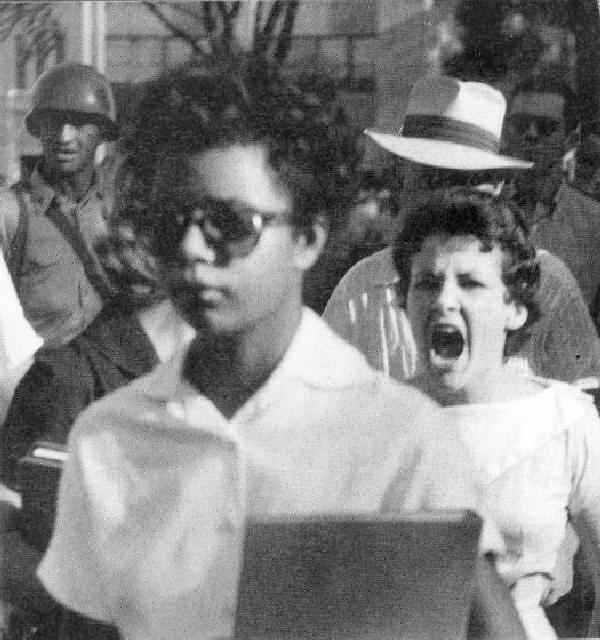
But our history says should we?

Race

Carrie Jean is a main character in Jumping: a Novel. She’s Native American, with a multi-tribal background, raised by a Navajo grandmother. The group of students she travels into the Void with come to rely on her spiritual rituals as reminders of gratitude. I, a white writer, venture into all those areas.

Nathan is another character, a fellow Void traveler, who is African American. I write of his family and history, too, and of his thoughts and dreams.

In another part of the book, I write about a Muslim man meeting his maker (who is a white non-Muslim woman from another life).

Is this right?

Some writers are still divided on this issue. Others offer advice (these happen to be cartoonists):

“Don’t just parachute them in.”

“Ask your PoC friends to read your stories. If you have to ask if something is racist, it probably is. Base your characters on real people, but don’t just project your own feelings into a stranger’s life. Don’t assume that because someone is a minority that they’ve lived a certain kind of life.”

—Maré Odomo, author and illustrator of Internet Comics
Source: http://midnightbreakfast.com/writing-people-of-color

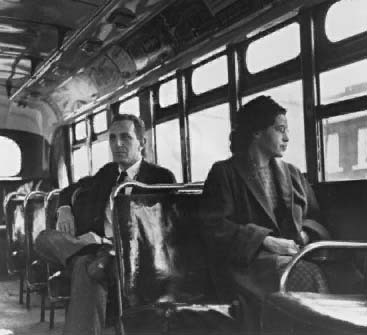
Is it better than the alternative?

Rosa-Parks-racism-free-9349328-367-335

I like to think so.

Amma hugs–I’ve had three. Why?

Standard

Amma
“Amma will embrace all these people tonight.”

‘My daughter, my daughter, my daughter,’ she says over and over in my ear.

I’m lost in the lap of something so much bigger than I am, and I rest there. All I can see is the folds of her white robe as I’m overwhelmed with the permeating scent of roses, which are everywhere. And then I’m falling out of the hug, as her attendants pull me back to put the next person in, pressing rose petals and strangely, a Hershey’s kiss into my hand.

I was charged with the energy of that hug for days after, hearing her words in my ear–‘My daughter, my daughter, my daughter.’

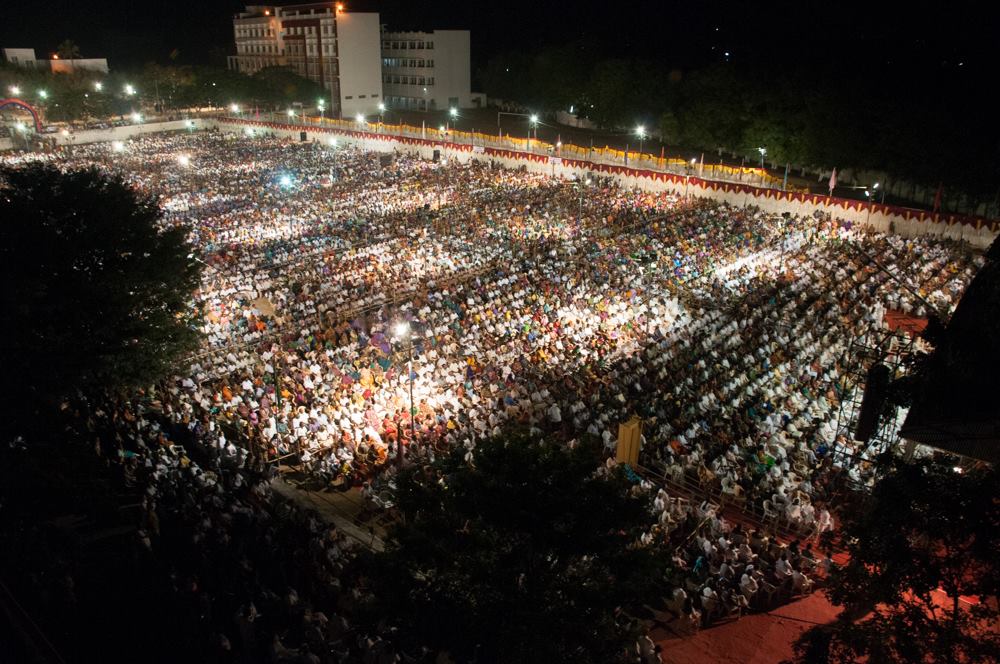
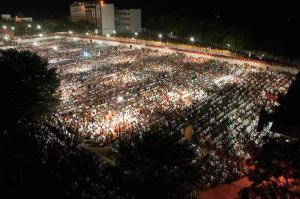
Once a year Amma, India’s hugging saint, comes to town. She arrives at a large hotel in Albuquerque that can accommodate the thousands who come for a hug, as crazy as that might sound. When you arrive, you remove your shoes, are organized into groups, given your hug number, fed and are presented with all kinds of memorabilia to buy, from photographs to clothes. While you wait for your group to be called, you listen to Indian music, are strewn with rose petals, watch multiple large-screen videos of Amma’s good works around the world, and look at everyone else who has come.

It all moves along smoothly. She and her team are experts at this–after all, she’s hugged more than 30 million people world wide, royalty and celebrities included.

When your group is called, you join a double line of people, in chairs, gradually moving forward, like musical chairs. Up ahead, Amma is dressed all in white, sitting on a sort of low throne, hugging people, one after another—families with babies, the old, the infirm, young people, people speaking different languages. When you’re finally next in line, her attendants move you to your knees a few feet from her, asking you what language you speak.

You’re sort of dropped into a tight group of front line attendants, dressed in yellow robes, who are plunging people into Amma’s lap and then dragging them out, in a claustrophobic frenzy. You’re in a feel-good, out-of-body daze as you’re pulled out.

At first I thought that wonderful feeling was from her, from what she has. After the third hug, I began to believe that we generate it together. She calls it forth, and what I feel is my soul answering.

Photo: Erode, Tamil Nadu, Monday, January 12, 2015

2014 in review–What was I thinking?

Standard

I have no idea what I was thinking. Now I can see that honestly following the course of my book, from my hands out into the world, garnered a few people’s interest. That, along with the tarantula migration I  witnessed. That goes without saying, of course, since who wouldn’t be interested in a tarantula migration?

Anyway, food for thought for the coming year. Here’s to everybody having a great one!

The WordPress.com stats helper monkeys prepared a 2014 annual report for this blog.

Here’s an excerpt:

A San Francisco cable car holds 60 people. This blog was viewed about 520 times in 2014. If it were a cable car, it would take about 9 trips to carry that many people.

Click here to see the complete report.

Tarantula Migration–Can they get in the car?

Standard

tarantula2

I lived in Roswell, NM, for about five years. I managed an HIV agency that served the southeastern quadrant of the state, 33,000 square miles, which was pretty impossible, with about 126 clients, so I did a lot of driving on little-traveled roads.
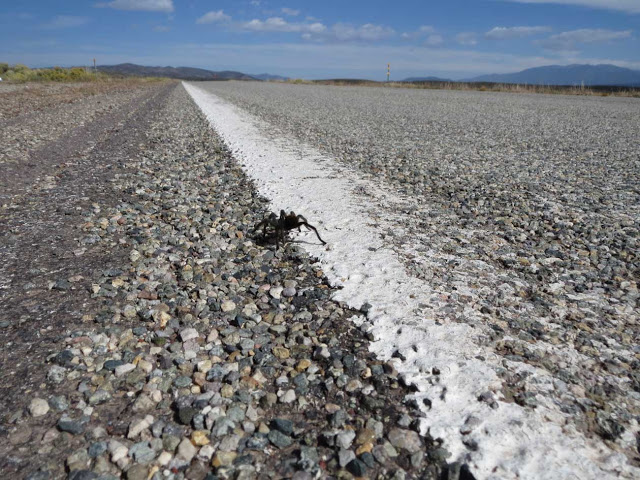
One night, driving home late, I was brought out of my usual driving stupor by catching sight of lots of small crawling things on the road. Tarantulas! I slowed but couldn’t help running over some of them and began to wonder if they could get into the car. What are they running from? Was it the end of the world? Would I be swarmed by them?
I didn’t know it at the time, but it was the annual tarantula migration. The males go in search, in mass, for female companionship. I couldn’t have imagined such a thing–except in a nightmare. I was horrified.
I later learned that a tarantula bite probably won’t kill you. I learned, too, that they’re gentle arachnids, nocturnal and shy, despite how scary they look.
I saw lots of other living things on the back roads I traveled–ring-tailed cats (just like out of Dr. Seuss), badger families, crowds of migrating jack rabbits lining the road, petite silver wolves, hawks, eagles–but I always remembered the tarantulas. Alone as I was, in the dark, being surrounded by lots of spiders (one of my worst fears), knowing I just had to get through it, wondering if it was a dream.
Lots of people think that part of NM is a wasteland, devoid of life, a desert. But it’s full of life, going about its business, searching for other like-minded partners, like we do.
What else don’t we know?

Photo from: rebeccamezoff.blogspot.com

Tasmania–running into the other you

Standard

launceston
Excerpt from Jumping: a Novel.
Babe has jumped into the Void and is meeting an aspect of herself whom she almost met in life:

One of them is a woman I saw once, in Tasmania. I’m surprised to see a woman with whom I have had only one encounter, and we never even spoke. . . .

I take in the woman, who looks strikingly like me, and remember seeing her in the crowd of evening strollers along the pier one night, on the Tamar River. . . I felt so strangely drawn to follow this woman, knowing there was some sort of connection, and hoping she knew it, too.

I think she was afraid of me—she noticed me, but only peripherally, and wouldn’t look at me head-on. I was a little freaked out—knowing she was me somehow, some other version of me. I wanted to see her and have her see me, as validation of something, but at the same time I felt as if something irrevocable would change, and I didn’t know if I was ready for that. I think she felt the same way.

The woman approaches. The silence lingers.

“Babe, this is Hardin,” Philip says, just as I’m thinking the name in my head.

“I know.”

Hardin and I hug. And Hardin, laughing, says, with a distinct Australian accent, “Of course, I did see you. I’m an aspect of you and you of me. It was my first time to ever see such a thing. I wasn’t well at the time, and I thought seeing you meant immanent death!” She laughs again, “I know now that’s not the case. And I’m sorry to have missed the opportunity, but I was a frightful little thing in that life. Not like you!”

“Oh, I was scared, too!” I reassure her.

The Snake

Standard

Water drops on blue background

From Jumping: a Novel.
Babe, on the arrival of her sisters. [I have three sisters.]

“I remember seeing a snake come down from the porch roof of a cabin I was staying in with friends. As we watched, it extended half of its length down through space as if the space had substance to support it, leaving its other half anchored on the porch roof. It lowered that front half right into a fir tree leaning against the porch, into the nest of a small mourning dove, a nest clearly visible to our group on the porch, a nest with two small eggs in it.
The dove had left the nest, probably because we had scared her off by coming out on the porch, and the snake had seen its chance. It moved into the nest with half of its body still on the porch roof, and swallowed both eggs, so quickly, so effortlessly, I could almost believe it hadn’t happened. I didn’t want to believe it had. Then it withdrew itself back up onto the roof, again as if suspended by invisible wires, and disappeared from sight. We stood there, silenced by the finality of its act. . . .
“Later I found a snakeskin tucked in the fold of the bottom step of the back porch. It was beautiful, elegant, like a woman’s elbow-length opera glove, dropped unheedingly, while she was on her way to somewhere else. . . .”